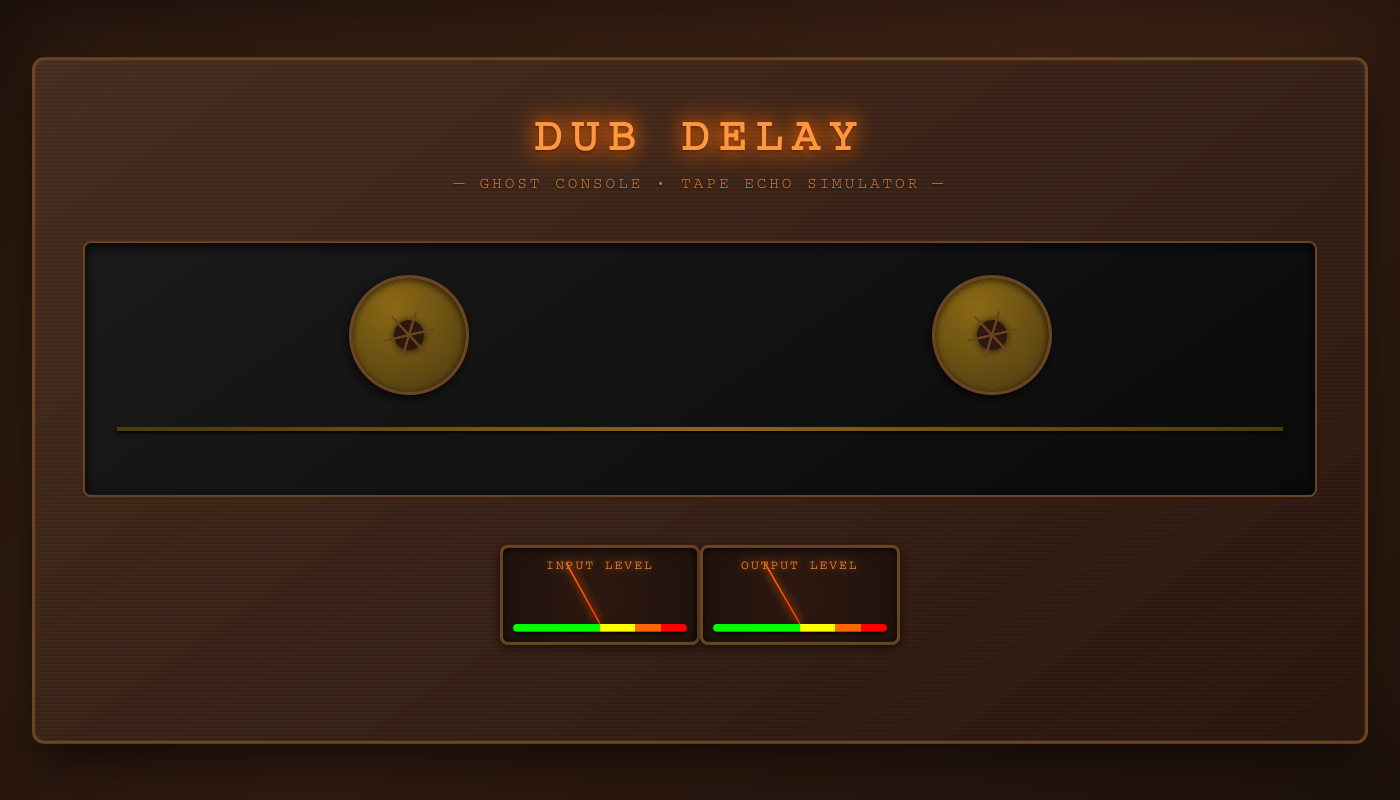
This interactive diagram is part of a larger educational series exploring the signal processing and production techniques that define dub music. By making these tools interactive and visual, we aim to demystify professional audio engineering concepts and honor the groundbreaking work of dub’s pioneers.
DUB DELAY — GHOST CONSOLE
70%
40%
600 ms
68%
1.5
Ready • Load audio or use default
🎚️ DUB DELAY SIGNAL PATH ANALYSIS
1. Complete Signal Flow
Main Signal Path
Feedback Loop
Parallel Dry Path
2. Feedback Loop Detail
How the feedback works:
• Signal enters delay, waits 320ms, then passes through HPF → Saturation
• 68% of the processed signal feeds back to the delay input
• This creates repeating echoes that get progressively darker (HPF) and warmer (saturation)
• Classic "tape echo" or "dub delay" sound
• Signal enters delay, waits 320ms, then passes through HPF → Saturation
• 68% of the processed signal feeds back to the delay input
• This creates repeating echoes that get progressively darker (HPF) and warmer (saturation)
• Classic "tape echo" or "dub delay" sound
3. Parallel Dry/Wet Mix Architecture
Mix architecture:
• Dry path (70%): Original signal passes through unchanged
• Wet path (40%): Signal goes through delay + effects chain
• Both paths sum at the analyser/output stage
• This preserves clarity while adding space and depth
• Dry path (70%): Original signal passes through unchanged
• Wet path (40%): Signal goes through delay + effects chain
• Both paths sum at the analyser/output stage
• This preserves clarity while adding space and depth
4. Code Implementation
function buildGraph() {
  source = ctx.createBufferSource();
  source.buffer = buffer;
  source.loop = true;

  // PARALLEL SPLIT
  source.connect(dry);              // → Dry path (70%)
  source.connect(delayNode);        // → Wet path starts here

  // WET PROCESSING CHAIN
  delayNode.connect(hpf);           // 320ms delay → HPF
  hpf.connect(sat);                 // HPF → Tape saturation
  sat.connect(fbGain);              // Sat → Feedback gain

  // FEEDBACK LOOP
  fbGain.connect(delayNode);        // 68% back to delay input ⟲

  // WET OUTPUT
  sat.connect(wet);                 // Tap wet signal (40%)

  // FINAL MIX
  dry.connect(analyser);            // Dry → Analyser
  wet.connect(analyser);            // Wet → Analyser
  analyser.connect(ctx.destination); // → Speakers
  analyser.connect(dest);           // → Recorder
}
5. Key Signal Processing Elements
🎛️ Delay Node
• Range: 1-1200ms (default 320ms)• Purpose: Creates time-delayed copies of the signal
• Dub context: 320ms ≈ dotted eighth note at 140 BPM
🎚️ High-Pass Filter
• Frequency: 20-8000Hz (default 420Hz)• Q Factor: 0.5-12 (default 1.4)
• Purpose: Removes low frequencies on each repeat
• Effect: Creates "darkening" echo decay, prevents mud buildup
📼 Tape Saturation
• Type: WaveShaper with tanh() curve• Range: 0-1 dB (4x oversampling)
• Purpose: Adds harmonic warmth and compression
• Effect: Simulates analog tape saturation, softens transients
🔁 Feedback Gain
• Range: 0-95% (default 68%)• Purpose: Controls how much signal feeds back into delay
• Effect: Higher = longer decay, more repeats
• Limit: Capped at 95% to prevent runaway feedback
🎵 Mix Balance
• Dry: 70% (0.7 gain) — maintains clarity• Wet: 40% (0.4 gain) — adds space without overwhelming
• Total gain: 110% — slight boost from effect
6. Recording & Visualization Pipeline
The analyser node provides dual outputs:
• Audio playback: to speakers and recording
• Visualization data: time domain for X/Y scope, frequency bins for spectrum
• Recording captures to WebM, then converts to WAV for download
• Audio playback: to speakers and recording
• Visualization data: time domain for X/Y scope, frequency bins for spectrum
• Recording captures to WebM, then converts to WAV for download
7. Classic Dub Delay Characteristics
✓ Feedback loop creates infinite decay (like vintage tape echo)
✓ High-pass filter darkens each repeat (tape head aging effect)
✓ Saturation adds warmth and compression (tape distortion)
✓ Parallel dry/wet maintains punch while adding space
✓ Long delay times (up to 1200ms) for spacious dub effects
✓ High feedback (68% default) creates long, evolving tails
This is the signature sound of:
• King Tubby, Lee "Scratch" Perry, Scientist
• Roland Space Echo RE-201, Echoplex EP-3
• Modern dub, reggae, and electronic music production
✓ High-pass filter darkens each repeat (tape head aging effect)
✓ Saturation adds warmth and compression (tape distortion)
✓ Parallel dry/wet maintains punch while adding space
✓ Long delay times (up to 1200ms) for spacious dub effects
✓ High feedback (68% default) creates long, evolving tails
This is the signature sound of:
• King Tubby, Lee "Scratch" Perry, Scientist
• Roland Space Echo RE-201, Echoplex EP-3
• Modern dub, reggae, and electronic music production